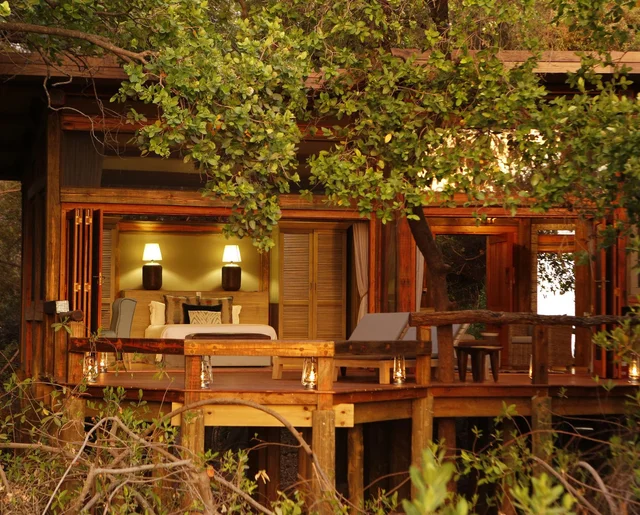
Well, for starters, the Moremi Game Reserve is situated in the Okavango Delta. Or, to be more specific, it covers most of its eastern sector. The reason why Moremi was elected as a game reserve instead of a national park was to still allow the native Bushmen and Batswana people (native to the land) to stay within the Moremi area in 1963, which made the Moremi the first protected reserve of the Okavango Delta.
In the 1970s, the royal hunting grounds, known as Chief's Island, was added to the reserve, which increased its capacity by 70 x 15 kilometres (44 x 10 miles) and became a protected area for wildlife.
The Okavango Delta encompasses approximately 15,000 km² (over 9000 miles²) of reeded waterways when most dry and can spread its width out to 22,000km² (over 13,000 miles²) when in high-water season. The low-water season can be experienced between November and April, and the high-water season can be enjoyed between June to October, during Botswana’s dry winter months. This is a guideline based on previous years; however, the water levels solely depend on the annual rains which flow from the elevated Angolan highlands funnelled through the Cubango and Cuito rivers.
As the powerful flow subsides, a palm-shaped bloom of green emerges as the Okavango Delta, home to a plethora of unique and interesting nature, including mokolwane palms, acacia, sycamore fig, sausage trees, raintrees, and African mangosteen. Not to mention the wildlife, including African elephant, African buffalo, hippopotamus, lechwe, topi, blue wildebeest, giraffe, Nile crocodile, lion, cheetah, leopard, brown hyena, spotted hyena, greater kudu, sable antelope, to name a few.